
Blown In Insulation: Repair or Replace? How Los Angeles Homeowners Decide
Most blown-in insulation doesn’t need replacing, it needs topping off. The deciding factors are settled depth, contamination, and whether air channels have formed through the material. If the existing insulation is dry, uncontaminated, and at least 5 inches deep at the joists, a top-off usually makes sense. If rodents have tunneled through it or moisture has compacted it, replacement is the only honest call. If you’d rather not climb into the attic to find out, call (254) 272-5876 and we’ll measure it for you.
Blown-In Insulation Fails Quietly, and Los Angeles Heat Speeds It Up
Blown-in insulation doesn’t fail dramatically. No visible cracks, no leak, no noise. It settles, a half-inch or more per decade, and every inch of settlement chips away at the R-value printed on the bag. In Los Angeles, the dry heat accelerates this. Fiberglass and cellulose lose loft faster in attics that hit 140 degrees in August, which is most attics from the San Fernando Valley down to Long Beach.
We pulled a sample out of an attic in Eagle Rock last month. The homeowner had a receipt from 2009 showing R-38 installed at 12 inches. What we measured was 7 inches in the center bays and 4 inches near the eaves. That’s R-19 in some spots, R-12 in others. The house was losing conditioned air through the ceiling and the homeowner had been running the AC harder for years without knowing why.
Here’s the point: blown-in insulation degrades in ways that batt insulation doesn’t. Batts sag. Blown-in settles and channels. The air you pay to cool in a Los Angeles summer finds every low spot, every gap where the material has thinned, and moves through it. The fix depends on how much material is left and what happened to it.
For a fuller picture of how insulation performs in this climate, see our Attic Insulation in Los Angeles page.
Measure the Depth Before You Decide Anything
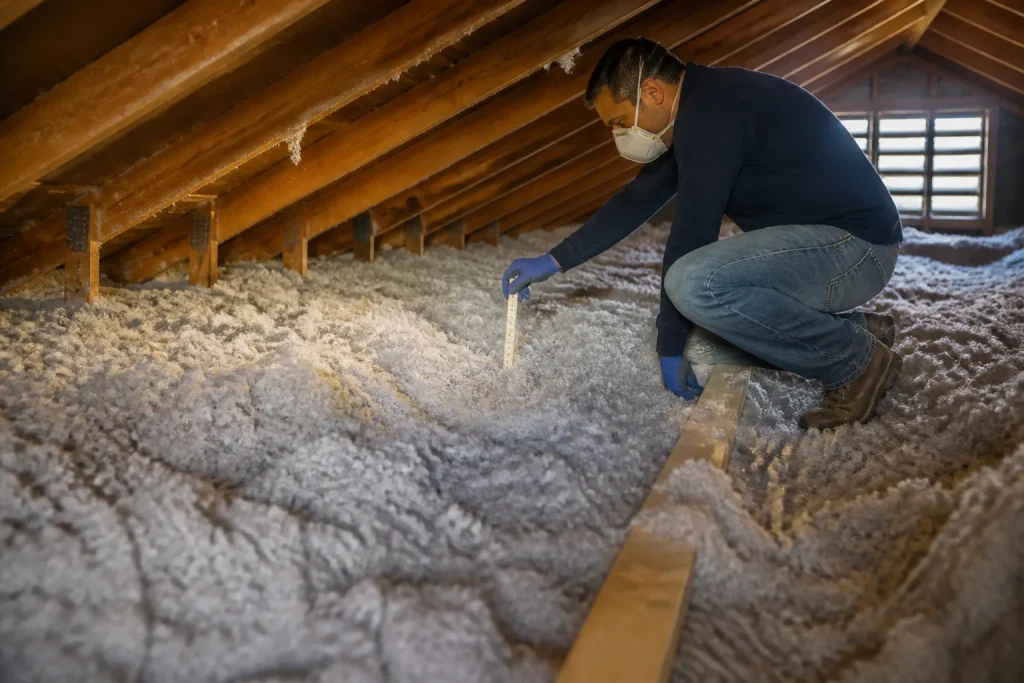
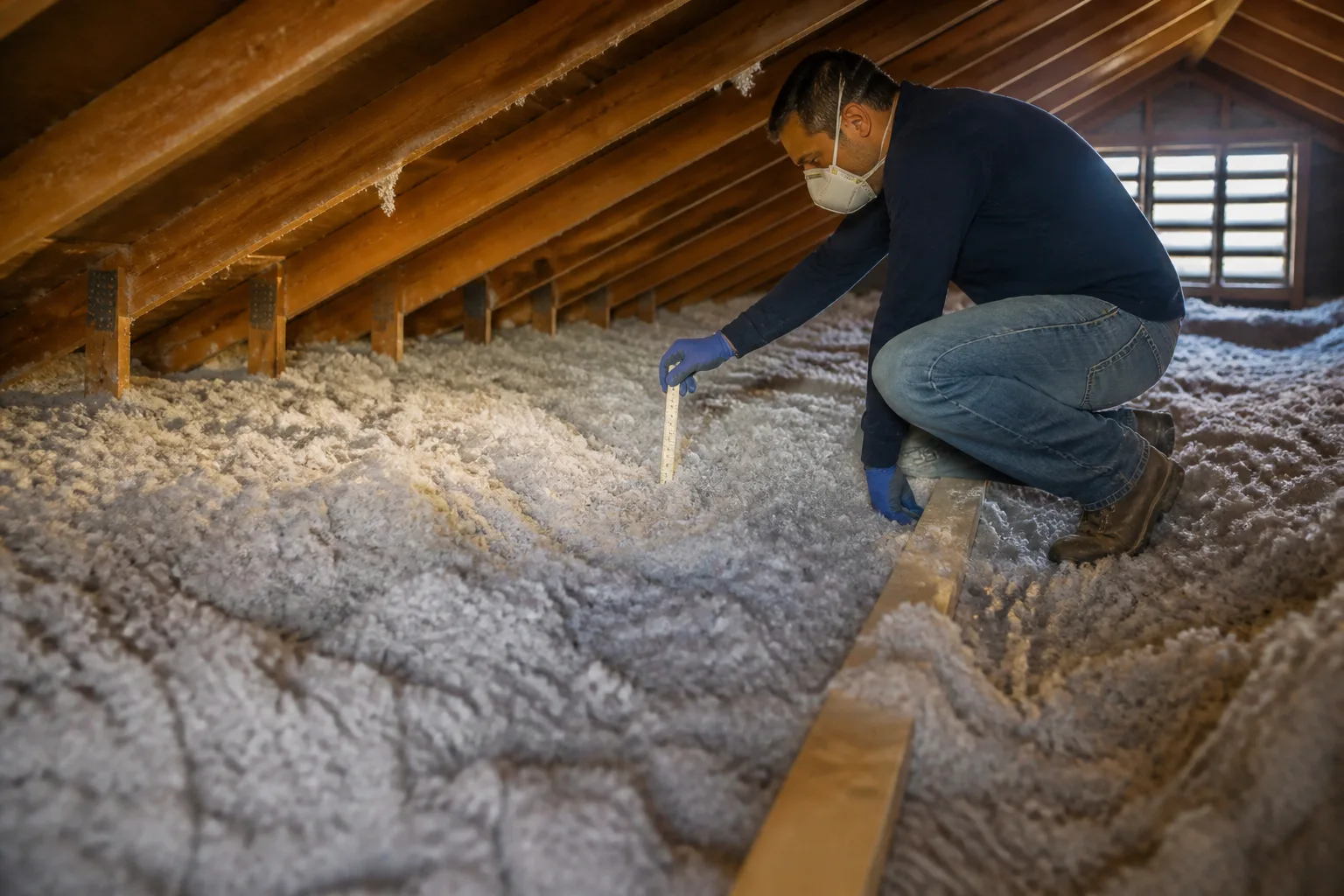
The repair-or-replace question starts with a tape measure. You need three numbers: the depth at the eaves, the depth at the center of the attic, and the depth at the joists. If those three numbers are close together, you have even settlement. If they’re far apart, you have air channeling, and that changes the recommendation.
Here’s how to read what you find in a Los Angeles attic:
- Original depth was 10-12 inches and it’s now 8-10 inches with even settlement: Top-off is the right call. The existing material still holds structure, and adding 4-6 inches of new blown-in fiberglass or cellulose brings you back to target R-value.
- Depth varies by more than 3 inches between the eaves and the ridge: Air is channeling through the low spots. A top-off can work, but only if the low spots are filled first, not just covered over.
- Depth is below 5 inches anywhere in the attic: There’s not enough base material left to build on. In most Los Angeles homes built before 1990, that means replacement.
- The material crumbles to dust when touched: This is common with old cellulose in attics that have baked for 30-plus years. It has lost its loft and its air-trapping ability. Top-off won’t fix it.
The math matters. Cellulose delivers roughly R-3.5 per inch. Fiberglass blown-in delivers R-2.5 to R-3.0 per inch depending on density. If the original install was R-38 at 11 inches of cellulose, and you’re now at 7 inches, you have R-24. That’s a 37% loss of thermal resistance. Your AC runs longer every summer day to make up the difference.
In Los Angeles, we recommend measuring after every major heat wave, not because the heat destroys insulation overnight, but because prolonged high temperatures accelerate the settling that’s already happening. An attic that hits 130-140 degrees for weeks at a time degrades material faster than an attic in a coastal mild-climate zone.
When a Top-Off Is the Right Call
A top-off is the least expensive way to restore R-value, and it’s the correct recommendation for the majority of Los Angeles homes we inspect. The conditions that make it viable are specific:
- Even settled depth: The material is thinner than it was, but the thickness is consistent across the attic floor.
- No contamination: No rodent droppings, no nesting, no water stains, no mold. The existing material is just old, not damaged.
- Material still holds structure at the joists: Fiberglass and cellulose that spring back when compressed are still trapping air. If it lies flat and dead, it’s not.
- No prior air sealing was done, and none is needed: If the original install blew insulation directly over an unsealed attic floor, the top-off is a band-aid over a leak. Air sealing has to happen first, which means removing at least some of the existing material.
When a top-off is done right, the crew blows new material directly over the old, bringing total depth back to the target. For Los Angeles, that target is R-38 in most zones, which Department of Energy guidance sets at 10-14 inches depending on the material. A top-off from R-24 back to R-38 typically runs $0.80 to $1.25 per square foot for the added material and labor.
We install blown-in fiberglass and cellulose from brands like CertainTeed, Rockwool, and GreenFiber. Homeowners can research any of them independently before signing a contract, which is how it should work. See our Blown In Insulation in Los Angeles page for specifics on the materials and process.
When Replacement Is the Only Honest Answer
Some attics can’t be salvaged with a top-off. The material has to come out and new insulation has to go in. The three conditions that force this decision in Los Angeles are rodent damage, moisture, and installation errors from the original job.
Rodent tunneling. Rats and mice in Los Angeles attics are a fact of life, especially in neighborhoods with mature trees and older homes. When rodents tunnel through blown-in insulation, they create air channels through the material. The insulation looks full from above, but underneath, there are highways of empty space where conditioned air pours through. You cannot fill these channels by blowing over them. The only fix is removal, sanitizing, air sealing the entry points, and fresh installation.
Moisture damage. A roof leak that dripped onto cellulose for six months before anyone noticed will compact the material into a mat. Once cellulose gets wet, it does not dry back to its original loft. It clumps, it loses R-value, and it becomes a mold substrate. In Los Angeles, this happens most often in homes where the AC condensate line runs through the attic and leaks, or where bathroom fans vent into the attic instead of outside.
Prior installation errors. The most common mistake we see in Los Angeles attics is blown-in insulation installed directly over an unsealed attic floor. Air moves through every gap around recessed lights, wiring penetrations, and top plates. The insulation filters the air but doesn’t stop it. The fix is removal, sealing, and reinstallation. Some Los Angeles homes built before 1980 also have original insulation that was never meant to last this long.
Full removal and replacement in Los Angeles runs $1.50 to $2.50 per square foot depending on access, depth of existing material, and whether air sealing is included. It is not the cheap option, but in a rodent-damaged or moisture-compromised attic, it is the only option that works. See our Insulation Removal in Los Angeles page if you need to know what removal involves.
The 7-Year Cost Comparison in Los Angeles
The repair-or-replace question eventually comes down to money. Here’s how the numbers break down for a typical 1,200-square-foot attic in Los Angeles:
- Top-off only: $960 to $1,500 total. Brings R-value from roughly R-24 back to R-38. Energy savings in an older Los Angeles home: roughly 10-15% on cooling costs per year. At an average LA-area electricity rate of $0.28 per kWh, a home spending $2,400 a year on cooling saves $240 to $360 annually. Payback: 3 to 5 years.
- Full removal and replacement with air sealing: $1,800 to $3,000 total. Brings the attic to R-38 or R-49 from a near-zero base, with all penetrations sealed. Energy savings: 20-30% on cooling and heating costs combined. Payback: 4 to 7 years.
The break-even point between the two options is around the 5-to-7-year mark in Los Angeles. If you plan to stay in the house for 7 years or more, the full replacement with air sealing wins on every financial metric. If you’re listing the house in two years, the top-off restores the R-value a buyer’s inspector will check for, and it’s the lower out-of-pocket cost.
One thing we tell every homeowner in Los Angeles: whatever you choose, get the numbers in writing before any work starts. A written quote for a top-off or a replacement should specify the existing depth measured, the target R-value, the material to be installed, bags per 1,000 square feet, and how post-install depth will be verified. If a contractor won’t put those numbers on paper, the quote isn’t a quote. It’s a guess.
The written price is in your hand before a single tool comes off the truck, and the number on the invoice matches the number you approved. Every job carries a Done Right Promise, in writing: if the work fails within a year, we come back and make it right at no charge.
What a Written Quote Must Include
Most Los Angeles homeowners have never bought insulation before, and the quote they get from a contractor is the only documentation they’ll ever see. Here’s what a legitimate blown-in insulation repair or replacement quote must specify:
- Existing depth measured: In inches, at the eaves, at the center, and at the joists. Not a range like “6 to 10 inches.” Three specific numbers.
- Target R-value: The quote should state the R-value the finished attic will reach, not just the inches of material added. R-38 is the common target for Los Angeles attics.
- Bags per 1,000 square feet: This is the number that tells you whether the contractor is actually going to install enough material. For R-38 cellulose, that’s roughly 32 bags per 1,000 square feet. If the quote doesn’t specify bags, the contractor hasn’t done the math.
- Post-install depth verification method: How will you know the attic got what the quote promised? The answer should be a depth gauge measurement at multiple points across the attic floor, documented with a photo. Not “trust us.”
At Alden Attic Insulation, every quote includes all four items. It’s the same discipline that applies across the Garrison Partners family of companies. The Garrison Standard is not a slogan; it’s a set of written commitments: a live person answers the phone 24/7, technicians are background-checked and arrive in uniform inside the scheduled window, and the price is written down before work begins.
If you want to see how this works in practice, read the Alden Attic Insulation home page or call (254) 272-5876 and ask for a measurement appointment. It takes about 45 minutes.
The Bottom Line
Blown-in insulation in Los Angeles usually needs a top-off, not a replacement. The exceptions are rodent damage, moisture damage, and original installation that skipped air sealing. Measure the depth first, look for contamination, and get the quote with the four spec points listed above. If the numbers show even settlement above 5 inches with no contamination, add material and move on. If they show anything else, replace it.
If you’re in Los Angeles and want a straight answer about your attic, call (254) 272-5876 for a free estimate. We’ll measure it, show you the numbers, and put the price in writing before any work starts.
Frequently Asked Questions
Measure the depth at the eaves, the center, and the joists. If all three measurements are within 2 inches of each other and the material is dry with no rodent signs, a top-off is the right call. If depth varies by more than 3 inches, or the material is contaminated, replacement is required. Call (254) 272-5876 and we’ll measure it for you.
A top-off in Los Angeles typically runs $0.80 to $1.25 per square foot, which puts most 1,200-square-foot attics between $960 and $1,500. Full removal and replacement runs $1.50 to $2.50 per square foot. The exact number depends on current depth, access, and whether air sealing is included.
Fiberglass and cellulose blown-in insulation can last 20 to 30 years in a Los Angeles attic, but the effective R-value degrades as the material settles. Attics that regularly hit 130 degrees or more lose loft faster. We recommend measuring depth every 5 years, and after any period where the AC ran unusually hard without explanation.
Top-off is cheaper upfront, usually 40-50% less than full replacement. But in a Los Angeles attic with rodent damage or missing air sealing, top-off doesn’t fix the underlying problem and you’ll pay for it in energy costs anyway. Full replacement with air sealing has a 4-to-7-year payback; top-off pays back in 3 to 5 years but doesn’t address roof leaks, rodent entry points, or bypass air.
Written by the team at Alden Attic Insulation.
Need Insulation Help?
Call Alden Attic Insulation - licensed & insured, here with fast after-hours help in Los Angeles.
(254) 272-5876