
Owens Corning Attic Insulation in Los Angeles: A Homeowner’s Guide
Owens Corning attic insulation in Los Angeles typically costs between $1,800 and $4,200 for a standard 1,200-square-foot attic, depending on whether you choose EcoTouch batts or AttiCat blown fiberglass and what R-value your home needs under California’s Title 24 code. The pink color is trademarked, but the installation depth is not, and that depth is the number that determines whether you actually get the R-38 or R-60 performance on your invoice. If you’d rather skip the research and get a straight answer, call us at (254) 272-5876 for a written estimate before any work starts.
We’ve been installing Owens Corning products in Los Angeles attics long enough to know one thing: homeowners who understand the spec checkpoints get better installations than homeowners who just pick a contractor and hope. This guide gives you those checkpoints.
EcoTouch vs. AttiCat: What’s Actually Going Into Your Attic
Owens Corning makes two main attic insulation lines you’ll see quoted in Los Angeles: EcoTouch batts (the pink rolls) and AttiCat blown fiberglass (the loose fill that gets machine-applied). They’re both fiberglass. They both meet California code when installed correctly. But they behave differently in LA attics, and the choice matters more than most contractors let on.
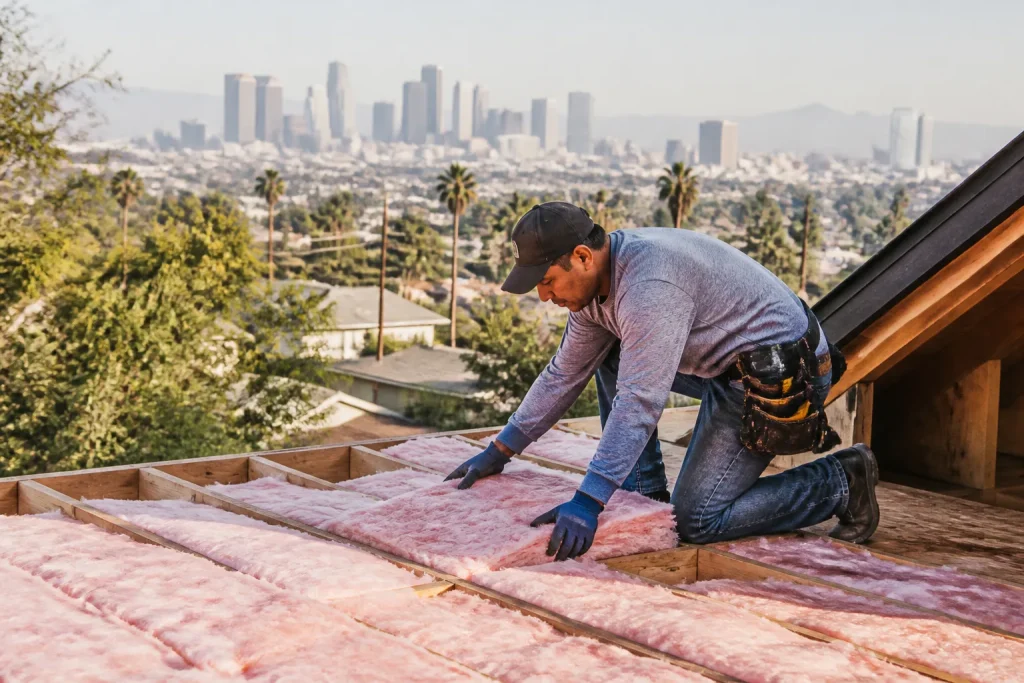
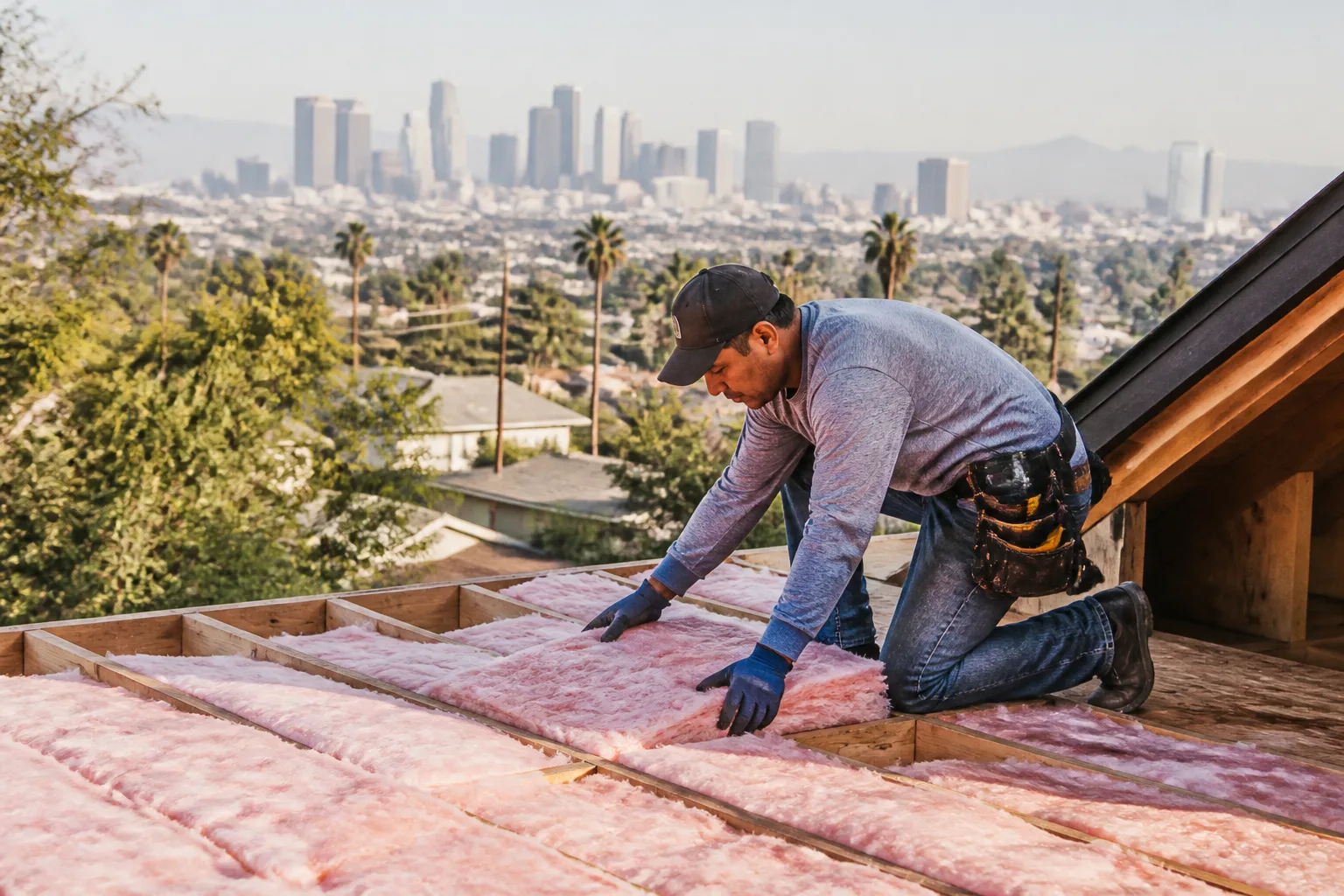
EcoTouch batts are pre-cut fiberglass blankets sized to fit standard joist and stud spacing. They’re straightforward to install between exposed joists, which makes them a reasonable choice for attics with clean, open bays and no obstructions. But Los Angeles attics are rarely clean and open. Lots of our city’s housing stock dates to the 1940s through 1970s, and those attics come with cross-bracing, recessed can lights, ductwork runs, and the occasional knob-and-tube remnant. Batts don’t conform around those obstacles. When they’re packed around a ceiling junction box, you get voids, and voids are where your conditioned air leaves the house.
AttiCat blown fiberglass is applied with a hose under pressure, and it fills around ducts, braces, and irregular joist spacing the way batts never can. That’s why we recommend blown for most Los Angeles attic geometry. It’s also faster to install at a uniform depth, which matters when you’re chasing an even R-value across the whole floor.
One more thing about EcoTouch: it’s faced with kraft paper on one side, and that facing is a vapor retarder. In Los Angeles, where summer attic temperatures routinely pass 130°F and winter crawlspaces stay mild, installing faced batts vapor-side-down in an attic floor can trap moisture against the drywall below if the attic isn’t properly vented. It’s a nuance plenty of rushed jobs get wrong.
Reading the Bags Chart: What Your Contract Should Actually Say
Owens Corning publishes a coverage chart for AttiCat that tells you exactly how many bags of material are required to hit a given R-value over a given square footage. It’s public information, and you should know how to read it, because it’s the single best tool for catching a short quote before it becomes a short installation.
Here’s how the math works. To reach R-38 in a 1,000-square-foot attic, AttiCat requires roughly 26 to 28 bags. To reach R-60, you’re looking at 40 to 42 bags. Those numbers matter because fiberglass performs differently at different depths, and the relationship between inches of material and R-value is not perfectly linear once the fiberglass starts compressing under its own weight.
When a contractor quotes a Los Angeles attic insulation job, the written scope should state the square footage, the target R-value, and the number of bags being installed. If a quote says “R-38 blown fiberglass” but the bag count works out to R-30 coverage, that’s not a rounding error. That’s a contractor planning to install less material than the job requires and hoping you never count the empty bags at the curb.
We write the bag count on every Owens Corning job we quote in Los Angeles. It’s part of The Garrison Standard: written prices, written scope, no surprises at invoice. You can verify the math yourself against Owens Corning’s published chart before you sign anything.
When 130°F Changes the Math: LA Heat and Effective R-Value
Los Angeles attics get brutally hot. In neighborhoods like Woodland Hills, Van Nuys, and Pasadena, attic temperatures in July and August regularly exceed 140°F. That heat doesn’t just make the space unpleasant. It changes how blown fiberglass performs.
The published R-value for AttiCat is tested at 75°F mean temperature. As attic temperature climbs above 130°F, the effective insulating performance of loose-fill fiberglass declines because the material’s resistance to radiative heat transfer drops. The insulation is still working, but it’s working less efficiently at the exact moment your home needs it most.
There are two practical responses to this. First, install to the higher end of the recommended R-value range for your climate zone rather than the bare minimum. California’s Title 24 currently requires R-38 in most Los Angeles attics, but bumping to R-49 or R-60 meaningfully offsets the summertime performance loss. Second, make sure your attic ventilation is functioning. A properly vented attic with balanced soffit and ridge vents moves hot air out before it turns the insulation into an oven liner, and that keeps effective R-value closer to the published number.
A quick note on safety: if you’re up in the attic checking either insulation depth or ventilation, stay on the joists. Drywall won’t hold a person’s weight, and a fall through the ceiling is a genuine risk. We’ve seen the aftermath, and it’s never worth the inspection. If you’re not comfortable moving around up there, call us and we’ll do the assessment as part of a free estimate.
Title 24 in Los Angeles: Meeting the Threshold, Not Just Approaching It
California’s Title 24 energy code sets minimum attic insulation requirements by climate zone, and Los Angeles County falls mostly within zones 6 and 8, which call for R-38 in existing homes when insulation is being added or replaced. That’s the floor, not the target.
The distinction matters because “approaching” R-38 is not “meeting” R-38, and there’s no partial credit in a Title 24 inspection. If the inspector measures 10.5 inches of settled AttiCat where 13.75 inches were specified to hit R-38 after settling, you fail. Settling is the operative word here. Blown fiberglass settles over time, especially in the first year, and a contractor who installs to the minimum depth on day one will have you below code by the following summer.
That’s why we install AttiCat to the settled depth printed on Owens Corning’s product spec sheet, not the initial fluffed depth. It costs a few extra bags, and the written price reflects it. The alternative is a homeowner who paid for R-38 and is living with R-34 by autumn.
If you want to check an existing installation in your Los Angeles home, a simple ruler and Owens Corning’s published minimum thickness chart are all you need. Measure in at least six spots across the attic floor. If you’re reading shallow, the material was under-installed or has compressed past its useful life, and Insulation Removal in Los Angeles may be the first step before a proper reinstall.
What the Owens Corning Installer Certification Actually Covers
Owens Corning certifies installing contractors through its contractor program, and the certification confirms the contractor has completed product-specific training on proper installation techniques for Owens Corning materials. That’s a meaningful credential, and it’s worth checking for when you’re comparing Los Angeles insulation companies.
What it does not cover is workmanship. Owens Corning’s warranty applies to the material itself, specifically that the fiberglass will maintain its published R-value and won’t deteriorate under normal conditions. If the contractor installs the product incorrectly, the material warranty doesn’t give you recourse against Owens Corning. Your recourse is against the contractor, and that’s only as strong as the contractor’s own written guarantee.
This is where the difference between companies shows up. A certification tells you the crew was trained on the product. A written workmanship guarantee tells you the company will stand behind the installation if something goes wrong. You need both. We carry the Owens Corning certification and we put our own Done Right Promise on top of it: if the installation fails within a year, we return and make it right at no charge, in writing, before we start the job. That’s the only structure that protects a Los Angeles homeowner from being caught between a material warranty that won’t apply and a contractor who’s gone.
We also install products from other manufacturers, including Rockwool, CertainTeed, and Icynene, because different Los Angeles homes call for different materials. A 1920s Spanish Revival in Silver Lake has different insulation needs than a 2005 tract home in Porter Ranch, and limiting ourselves to one brand would mean forcing a product onto a house it wasn’t right for. You’re welcome to research all of them before deciding.
When to Call a Pro
We’ve handled enough Los Angeles attic insulation jobs to know there are honest DIY projects and then there are attic projects, and the difference usually comes down to three things: access, air sealing, and code. If your attic has adequate headroom, open joists, no recessed lighting, and you’re comfortable working in a 140°F space, re-batting an attic is physically possible. Plenty of homeowners do it. What most DIY jobs miss is the air sealing step that should happen before insulation goes down, sealing the top plates, plumbing penetrations, and electrical boxes where conditioned air leaks into the attic year-round. Miss that, and you’re putting a warm blanket over a leaky bucket.
There’s also the matter of old insulation. If you have vermiculite, rodent damage, or blown fiberglass that’s gone gray and packed down to the consistency of cardboard, removal is a job for professionals with the right equipment and disposal protocol. We pulled a few hundred pounds of raccoon-soiled fiberglass out of an attic in Atwater Village last spring, and nobody in that household should have been breathing that air, let alone hauling it out themselves.
If you’re in Los Angeles and want this handled by a crew that arrives in uniform, gives you a written price before starting, and stands behind the work for a full year, call us at (254) 272-5876. We answer the phone with a live person, not a menu tree.
Related Services in Los Angeles
If you’re weighing Owens Corning products against alternatives, start with our Attic Insulation in Los Angeles page for a broader look at material options, R-value guidance, and local pricing. Homeowners specifically interested in blown fiberglass applications should read Blown In Insulation in Los Angeles, which covers depth requirements, coverage charts, and the installation process in detail. And if your attic has old, damaged, or contaminated insulation, Insulation Removal in Los Angeles walks through when removal is necessary and what it costs before new material goes down.
What happens when you call
- 1
A real person answersNo phone trees - you reach a local pro.
- 2
You get an upfront price rangeHonest numbers before anyone is dispatched.
- 3
A background-checked tech heads outLicensed & insured, dispatched right away.
- 4
You approve before work beginsNothing starts until you say go.
The Bottom Line
Owens Corning’s AttiCat and EcoTouch products are solid, well-documented materials, and they’re the right choice for a lot of Los Angeles homes. But the product only performs as well as the installation behind it. That means verifying the bag count on your quote, insisting on settled-depth specifications, understanding how LA summer heat affects fiberglass performance, and asking the contractor what written workmanship warranty comes with the job. A pink product doesn’t guarantee a proper installation. The documentation does.
If you’re in Los Angeles and need help sorting out your attic insulation options, Alden Attic Insulation home is a good place to start. We offer free estimates with a written price before any work begins. Call (254) 272-5876.
Frequently Asked Questions
Most Owens Corning attic insulation projects in Los Angeles run between $1,800 and $4,200 for a standard 1,200-square-foot attic. AttiCat blown fiberglass installed to R-38 typically lands around $2,200 to $2,800, while R-60 runs higher due to the extra material. EcoTouch batt installations are generally less expensive for open attics but lose their cost advantage when obstructions require custom fitting. Call (254) 272-5876 for an exact written quote, which is free.
California’s Title 24 code requires R-38 in most Los Angeles attics for existing homes when insulation is being added or replaced. However, given how hot LA attics get in summer, we recommend installing to R-49 or R-60 whenever the attic depth allows. The incremental cost is modest compared to the year-round energy loss from under-insulated attics in our climate.
For most Los Angeles homes, AttiCat blown fiberglass is the better choice because it fills irregular joist spacing, conforms around ducts and braces, and achieves uniform depth without cutting and fitting. EcoTouch batts work well in open, unobstructed attics with standard joist spacing. Both are structurally sound products; the right answer depends on your attic’s geometry.
Measure the settled depth of the insulation in at least six spots across your attic floor and compare it to Owens Corning’s published minimum thickness chart for your target R-value. Check that the material is uniformly distributed with no bare patches or shallow spots. And confirm the contractor’s written scope included the correct bag count for your square footage. If you’re unsure, call (254) 272-5876 and we’ll inspect it as part of a free estimate.
Written by the team at Alden Attic Insulation.
Need Insulation Help?
Call Alden Attic Insulation - licensed & insured, here with fast after-hours help in Los Angeles.
(254) 272-5876