
Rockwool Attic Insulation in Los Angeles: A Homeowner’s Guide
Rockwool attic insulation in Los Angeles typically costs $1.10 to $1.60 per square foot for materials alone, which runs 30 to 40 percent higher than fiberglass batts with comparable R-value. Whether that premium makes sense for your home depends on where you live in the city, how your attic is built, and what you’re really trying to protect against. Rockwool earns its price in wildland-urban interface zones and homes with existing moisture problems at duct penetrations. Everywhere else, blown-in cellulose often delivers better value for the same R-value target. If you’d rather skip the research and get a straight answer for your specific attic, call us at (254) 272-5876.
Key Takeaways:
- Los Angeles attics routinely hit 140°F in July, and Rockwool’s dimensional stability under that sustained heat is its most underrated advantage.
- Rockwool batts require precise friction-fit installation between joists; older LA homes with non-standard joist spacing create real fit problems.
- Rockwool’s non-combustible rating resists ember ignition in WUI zones, but it does not make the attic structure itself fire-safe.
- For standard flat attics with accessible joist bays, blown-in cellulose reaches the same R-value for roughly 40 percent less material cost.
What Rockwool Actually Is
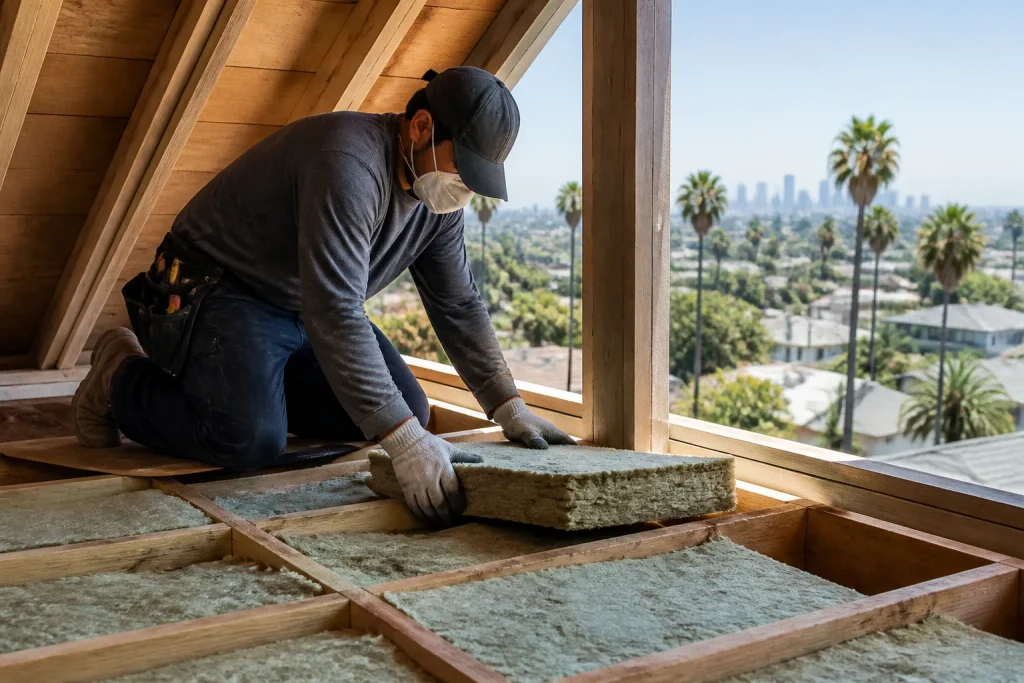
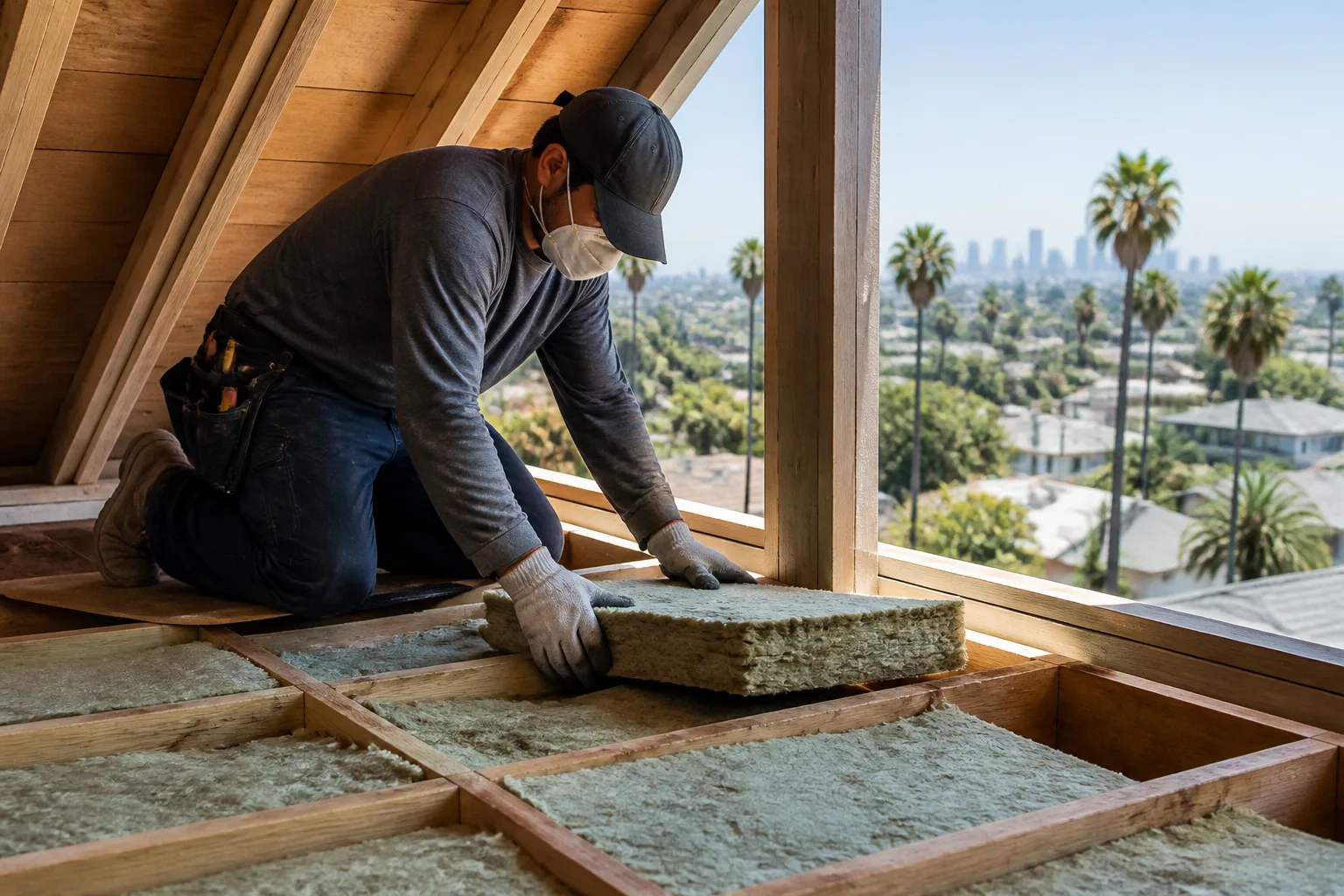
Rockwool is mineral wool insulation made from basalt rock and slag, spun into fibers and formed into batts or boards. It’s denser than fiberglass, holds its shape permanently, and does not require a vapor barrier in Los Angeles’s climate. The material carries a non-combustible rating, which means it will not ignite or contribute fuel to a fire when exposed to flame or embers. That’s different from being fireproof: the attic framing around the insulation still burns. What Rockwool does is refuse to add fuel to the fire, and in an attic where embers can enter through vents during wildfire conditions, that matters.
We install Rockwool alongside Attic Insulation in Los Angeles projects where the home’s specifics justify the material cost. It’s never a default recommendation from us, and it shouldn’t be one from any contractor who’s actually looked at your attic.
Why Fire Rating Matters in Los Angeles, and Where It Doesn’t
Los Angeles has over 90,000 homes in designated wildland-urban interface zones, stretching from the foothills of the San Fernando Valley through the Santa Monica Mountains and into the canyons above Pasadena. In those areas, Cal Fire and local building codes now require specific vent designs and ember-resistant construction. Insulation is not currently mandated to carry a non-combustible rating, but homeowners in WUI zones increasingly choose it anyway.
Here’s the honest distinction: Rockwool resists ignition from embers that land directly on it. That’s a real defense mechanism when wind-driven embers get blown through gable vents or soffit gaps during a Santa Ana event. What Rockwool does not do is protect the roof sheathing, the trusses, or the framing members that actually hold your house together. If a fire reaches your attic, mineral wool insulation buys you minutes of reduced fuel contribution, not structural protection.
Outside WUI zones, in neighborhoods like Mid-Wilshire or the flats of the San Fernando Valley, the fire-resistance argument for Rockwool weakens considerably. If you live in a dense residential block where wildfire isn’t a realistic threat, you’re paying a 30 to 40 percent material premium for a property you likely don’t need. That’s not a mark against Rockwool. It’s just a clear-eyed look at what the product is for.
How Much Does Rockwool Attic Insulation Cost in Los Angeles?
Here’s what we quote across Los Angeles attics, based on current material and labor rates:
| Insulation Type | Material Cost per Sq Ft | Installed Cost per Sq Ft | R-Value at 13″ Depth |
|---|---|---|---|
| Rockwool batts | $1.10 – $1.60 | $2.50 – $3.80 | R-38 to R-42 |
| Fiberglass batts | $0.40 – $0.75 | $1.20 – $2.20 | R-38 |
| Blown-in cellulose (GreenFiber or Johns Manville) | $0.35 – $0.60 | $1.10 – $1.90 | R-38 to R-49 |
| Blown-in fiberglass (Owens Corning or Knauf) | $0.40 – $0.70 | $1.20 – $2.00 | R-38 to R-49 |
Rockwool’s R-value per inch runs about R-4.0 to R-4.3. Blown-in cellulose runs close behind at R-3.5 to R-3.8 per inch, and fiberglass batts deliver R-3.2 to R-3.7 depending on density. At standard Los Angeles attic depth targets of 10 to 13 inches for R-38 or R-49, blown-in materials reach the same thermal performance for significantly less money because the material itself is cheaper and the installation is faster.
The math favors Rockwool when your attic has sections that can’t be blown: open-rafter cathedral ceilings, knee walls, or areas where a tray ceiling from the 1960s leaves awkward cavities. In those situations, blowing cellulose into the space is either impossible or requires netting and adhesives that kill the cost advantage. Rockwool batts, cut to fit and friction-installed, become the clean solution that also happens to carry the fire and moisture benefits.
The Moisture Advantage: Why It Matters in Older LA Homes
Los Angeles gets 14 inches of rain in an average year, almost all of it between November and March. But the moisture problem in our attics rarely comes from rain. It comes from condensation at duct penetrations, bathroom exhaust fans venting into the attic instead of through the roof, and the temperature differential between air-conditioned living space and a 140-degree attic in summer. Older homes, particularly post-war construction in neighborhoods like Westchester, Van Nuys, and the flats of Torrance, were built with attic ventilation that barely meets the minimum and duct runs that leak conditioned air.
Here’s the specific failure mode: a duct penetration in the ceiling leaks cool air into a hot attic during July. The cool air meets hot attic air and condensation forms on nearby surfaces. Fiberglass batts absorb that moisture, and wet fiberglass loses thermal performance immediately. The same batts then sit damp for weeks until the attic finally dries out, if it ever does. This is why we pull mold-stained fiberglass out of older Los Angeles attics on a regular basis.
Rockwool does not absorb water. It’s hydrophobic. Incidental moisture at duct penetrations will not degrade its R-value, and it won’t support mold growth the way organic fibers like cellulose can when they get wet. We’ve pulled one out of a garage over in Encino last year where a bathroom fan had vented into the attic for a decade. The fiberglass was black and sagging. The homeowner asked why we didn’t suggest Rockwool from the start, and honest answer was that nobody had looked at the vent when the original insulation went in. The air sealing should have been caught first. Rockwool would’ve held up better, but the real fix was correcting the vent.
Installation Reality: What Most Blog Posts Skip
Rockwool batts in attic applications require friction-fit installation. That means the batt must press firmly against the sides of the joist bay along its entire length and at consistent depth. Rockwool is stiff and dense, which is an advantage for dimensional stability but a disadvantage if your joist spacing is irregular. Pre-war Los Angeles homes in neighborhoods like Angelino Heights or parts of Long Beach frequently have joist spacing that runs 15 to 17 inches instead of the modern 16 or 24. That extra half inch means the batt doesn’t compress into place properly, or it needs to be cut along its length, which eats labor hours.
Compression is the silent enemy. A Rockwool batt compressed to half its intended depth loses roughly 20 percent of its R-value. Gaps around the perimeter create thermal bypasses that can drop effective R-value by 30 percent or more. The same is true of blown-in materials, but blown-in insulation doesn’t have fit problems. It conforms to whatever the existing framing is, and that’s a significant advantage in Los Angeles where a century of construction has produced every joist spacing imaginable.
When we quote Blown In Insulation in Los Angeles projects, we’re usually able to hit R-49 without any fit issues. When we quote Rockwool, we budget for slower installation and verify joist spacing before we give a written price. If the spacing is irregular, the labor cost closes the gap between Rockwool and blown-in alternatives, and homeowners should know that before they commit.
Who Should Choose Rockwool in Los Angeles
Here’s the candidate profile we use, and it’s done two different ways because the honest answer depends on your house.
Rockwool is the right call if you meet two or more of these:
- You’re in an established wildland-urban interface zone. Check the Cal Fire LRA maps. East of the 405 in the Sepulveda Pass, the hills above Glendale, or the canyons in the western San Fernando Valley all qualify.
- Your attic has open-rafter cathedral sections where blown-in material can’t be installed cleanly.
- You’ve seen moisture staining around existing fiberglass batts at duct penetrations, or you’ve smelled mold in the attic after a wet winter.
- You plan on using the attic for storage and want a surface you can walk on without compressing the insulation to nothing.
Blown-in cellulose remains the better value if:
- You have a standard flat attic with accessible joist bays and no WUI requirements.
- Your joist spacing is irregular or your trusses aren’t uniform, because blown-in material conforms to all of it.
- You’re targeting R-49 across the entire attic, and you want the lowest installed price that hits the target.
- You don’t plan to use the attic for anything except insulation and possible future mechanical work.
GreenFiber and Johns Manville both make blown-in cellulose products we install regularly. Owens Corning and Knauf produce blown-in fiberglass. If you want to research materials before making a decision, those are the names to look up. Every brand we install airs on our trucks by name, not by vague reference.
What the 365-Day Done Right Promise Covers
We hold every job in Los Angeles to The Garrison Standard, which came with the company when it was founded in 2002 and applies at every location in the Garrison Partners family. The standard requires a written price before any work starts, a background-checked and uniformed crew inside the scheduled window, and a written guarantee on the finished work for 365 days. If the insulation we installed fails within that year, we come back and make it right at no charge. The second visit is already included, not something you have to negotiate for.
That guarantee applies to Rockwool installations the same way it applies to blown-in cellulose and Insulation Removal in Los Angeles. The material matters, but the standard doesn’t shift based on what we’re installing. If your attic had fit problems we missed, if the batts settle, or if a section fails to hold its R-value, the guarantee kicks in. No arguments about whether it’s a material problem or an installation problem. That’s the discipline of a written standard.
When to Call a Pro
Rockwool installation isn’t a DIY project unless you know your joist spacing exactly and have the right tools to cut the batts cleanly. The material is stiff and unforgiving, and gaps or compression in a finished attic are nearly impossible to detect without a thermal camera and a blower door test. We run both on higher-end installations where the homeowner wants independent verification that the target R-value was actually achieved. More importantly, if your attic has any electrical wiring, and every Los Angeles attic does, you’re working around live conductors in a confined hot space. That’s not the place to learn on the job.
Related services in Los Angeles: we do Alden Attic Insulation home energy assessments, air sealing before insulation goes in, and full insulation removal when the existing material is mold-contaminated or compressed beyond recovery. If you pull back an old batt and find rat droppings or water staining, stop and make the call. Removing contaminated insulation is a separate job, and attempting to insulate over it makes every problem worse. The Alden number is (254) 272-5876, and a person answers it at 3 AM the same way they answer it at noon.
The Bottom Line
Rockwool is a genuinely excellent insulating material with specific performance advantages that matter in Los Angeles attics. Its non-combustible rating provides real protection against ember ignition in WUI zones, its moisture indifference prevents R-value loss at duct penetrations that plague older homes, and its dimensional stability means it holds its shape and R-value through 140-degree summers. What it doesn’t do is make sense as a default recommendation. For most Los Angeles homeowners with standard flat attics outside of fire zones, blown-in cellulose or fiberglass reaches the same R-value for a lower installed price, and the 365-Day Done Right Promise we offer at Alden Attic Insulation applies to every material equally.
If you’re in Los Angeles and trying to decide between Rockwool and blown-in insulation for your attic, call us at (254) 272-5876. We’ll ask about your joist spacing, your vent design, and where in the city you live. The estimate is free, and the written price you get is the same number on the invoice when the job is done.
Frequently Asked Questions
Rockwool is worth the 30 to 40 percent material premium only if you live in a wildland-urban interface zone, have open-rafter cathedral sections, or have existing moisture problems at duct penetrations. For a standard flat attic in dense residential Los Angeles, blown-in cellulose reaches the same R-value for less money. Call (254) 272-5876 and we’ll help you assess your specific home.
Rockwool resists ignition from embers landing in the attic and does not contribute fuel to a fire. It does not make the attic structure itself fire-safe. In wildland-urban interface zones in Los Angeles, that ember resistance matters. Outside WUI zones, the fire benefit is less relevant.
Rockwool is hydrophobic, meaning it does not absorb water. In our Los Angeles climate, condensation at duct penetrations degrades fiberglass batts but does not affect Rockwool’s R-value. If you’ve seen moisture staining in your attic, Rockwool becomes a stronger candidate than it would be otherwise.
Yes, but it costs more in labor because the batts must be cut along their length to fit irregular spacing. Older Los Angeles homes often have joist spacing that varies by a half inch or more. We verify spacing before quoting a written price so the number you approve is the number you pay. Estimates are free at (254) 272-5876.
Written by Bryce Holloway, Owner at Alden Attic Insulation, serving Los Angeles since 2002.
Need Insulation Help?
Call Alden Attic Insulation - licensed & insured, here with fast after-hours help in Los Angeles.
(254) 272-5876